
Hybrid meeting demand has pushed mid-market conference rooms—typically 8-20 seats—into the most common AV refresh category for commercial integrators. Q-SYS remains the default DSP platform on many of these jobs because it handles both audio routing and control in a single compile. Between the two compact Cores, the decision usually comes down to analog I/O count, AEC instance limits, and whether the room will need future expansion without a hardware swap.
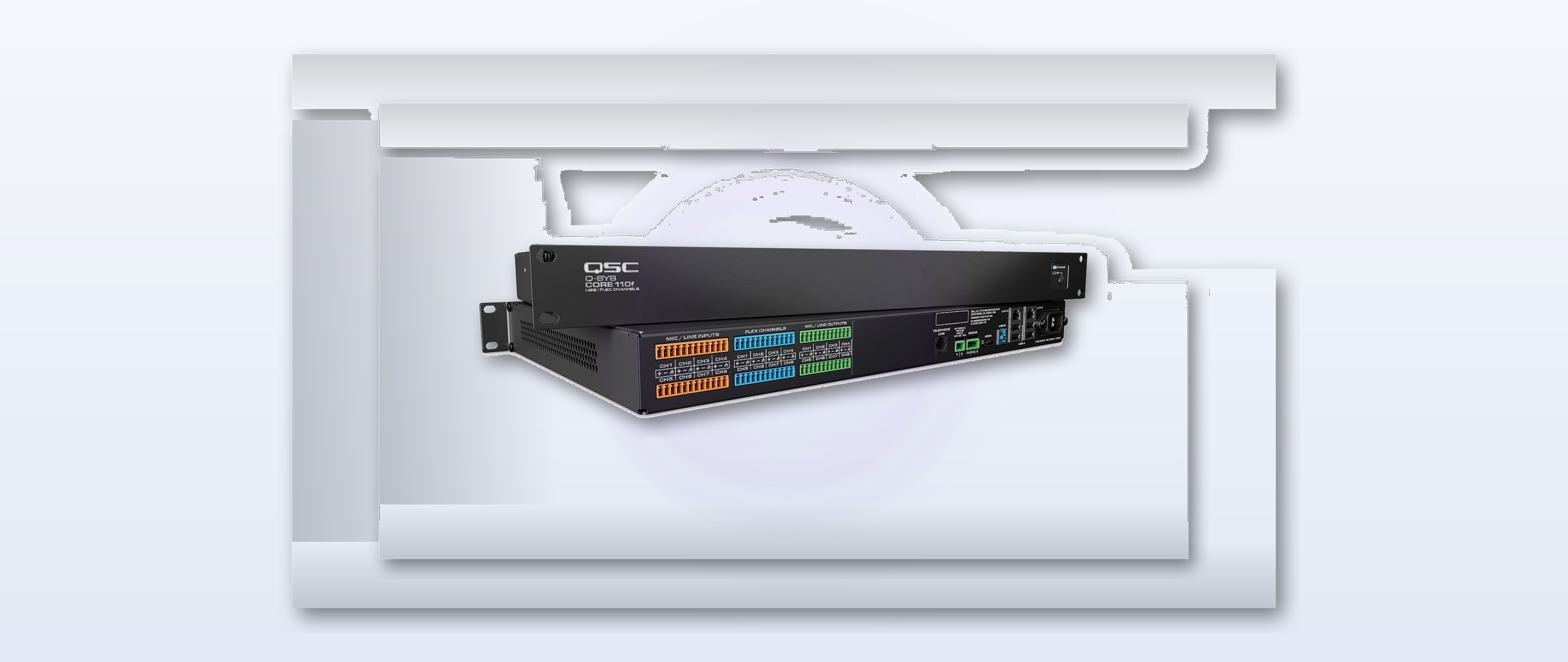
The Core 110f carries eight mic/line inputs and eight outputs on the chassis plus two card slots that accept the ACD-110 or other I/O cards. Its DSP pool supports up to 16 channels of AEC with full-band processing and still leaves headroom for multiple loudspeaker zones or USB bridging. The Core Nano, by contrast, ships with four inputs and four outputs fixed on the rear panel and no card slots. Its AEC capacity tops out at six instances before the compile starts dropping other blocks, which is adequate for a single table array plus ceiling mics but tight once video DSP or multi-zone paging is added.
Where the Two Platforms Diverge on Real Jobs
Installers who have run both units report the Core Nano finishes commissioning 20-30 percent faster on straightforward rooms because there are fewer I/O decisions and the chassis mounts directly to a 2RU shelf or wall bracket. Cable pulls shrink accordingly; a typical Nano job uses one 8-pair snake to the table and a single CAT5e run for the control touch panel. The Core 110f requires more upfront planning for the card slots and often an additional rack space for the larger power supply, but the same chassis can later accept a Dante card or extra analog card without replacing the processor. On bids where the owner might add a second display or wireless presentation system within three years, the 110f avoids a second truck roll and recompilation.
Parts cost delta sits around $1,800-$2,200 depending on distributor pricing, yet that gap narrows once labor and potential change orders are factored. A Nano install that later needs a second Core or an external mixer adds both hardware and another Q-SYS Designer file to maintain. The 110f also ships with more GPIO and a second LAN port, which matters when the room integrates with a building BMS or when the integrator wants to keep media and control traffic on separate VLANs. For rooms that already carry a Shure or Sennheiser Dante array, the 110f’s native 128x128 Dante capacity removes the need for an external bridge.
Looking ahead, Q-SYS software releases continue to shift more processing into the Core itself rather than external appliances. Integrators who standardize on the 110f today are positioning projects for easier adoption of newer camera tracking or AI noise suppression blocks without exceeding the existing hardware limits. Those staying with the Nano should treat it as a single-purpose endpoint and budget for a larger Core on the next refresh cycle.
Real-world testing in 12- to 16-seat rooms shows the Core 110f maintaining consistent full-band AEC even when four USB soft-codec streams and two VoIP instances run simultaneously. Latency stays below 4 ms through the entire signal path, preserving lip-sync for dual-display installs. The Nano, while adequate for single-platform Zoom or Teams calls, begins to exhibit minor dropouts once an additional Bluetooth bridging block or background-music zone is added to the design.
Both processors integrate directly with Q-SYS Reflect Enterprise Manager, yet the 110f’s extra LAN port allows dedicated outbound traffic for health telemetry without touching the control VLAN. This separation proves useful when facility managers require independent monitoring of HVAC and lighting subsystems that share the same building network.
Service contracts also favor the larger chassis. Q-SYS Certified partners report that spare 110f units can be pre-configured and swapped in under 15 minutes using a USB backup file, whereas Nano replacements often require on-site recompilation because of tighter DSP budgets. Over a five-year horizon, the incremental hardware cost is typically recovered through reduced service calls and avoided redesign fees.

Ultimately the choice hinges on whether the room is treated as a fixed asset or a living endpoint. Projects forecasting stable single-platform use and tight budgets can confidently specify the Nano; anything with growth potential, multi-zone needs, or external Dante arrays benefits from the headroom and slot architecture of the Core 110f.


