
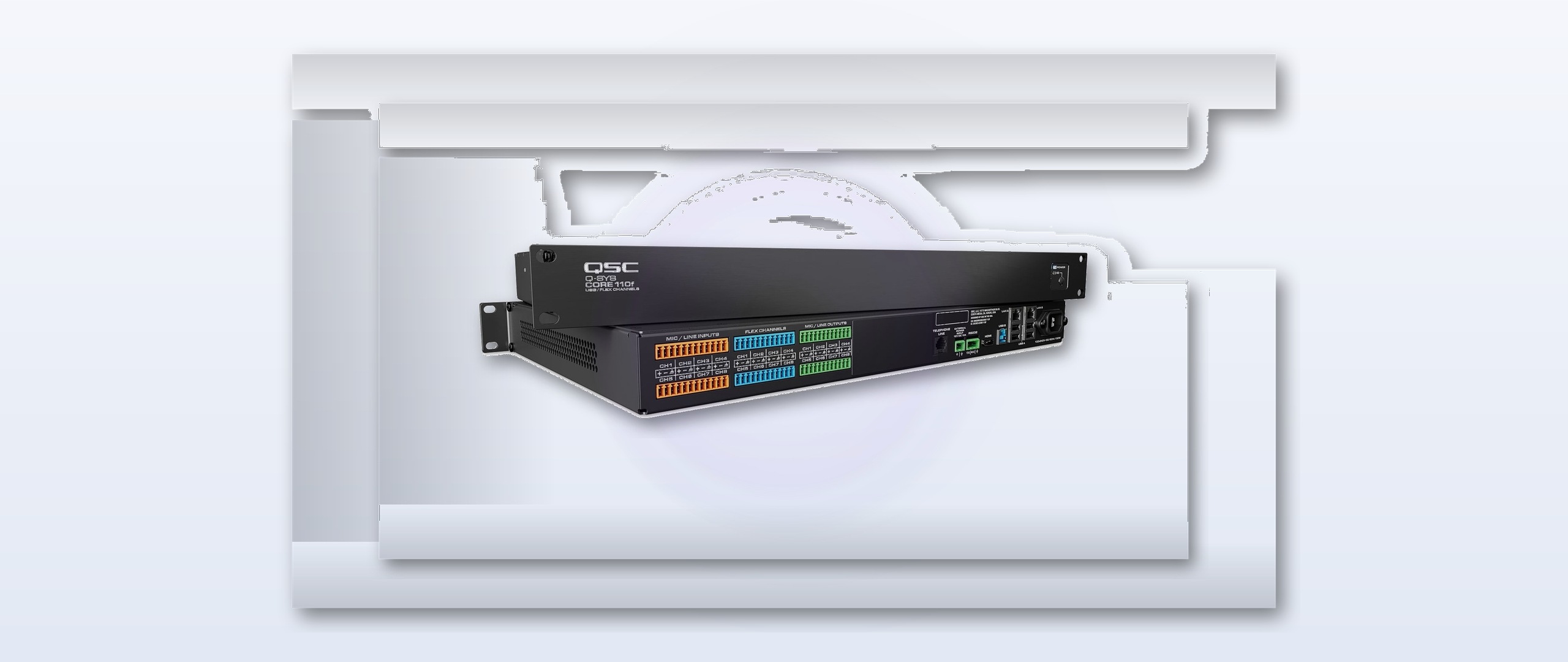
Hybrid meeting demand has pushed mid-market conference rooms into the 12-to-20-person range as the most common AV refresh target. These spaces typically need four to eight table mics, acoustic echo cancellation, USB or Dante tie-in to a PC, and basic control of displays and shades. The Q-SYS Core 110f and Core Nano both run the same Designer software, yet they differ enough in DSP allocation and physical I/O that one usually fits the budget and schedule better than the other.
The Core 110f supplies 24 channels of AEC, eight flex I/O ports that can be configured as mic/line or GPIO, plus built-in 8x8 USB audio and dual gigabit ports. That capacity lets a single chassis handle a full array of Shure MXA or Sennheiser TeamConnect mics, route multiple program sources, and still leave DSP overhead for future Q-SYS Control scripts or camera tracking. The Core Nano, by contrast, offers four analog inputs and four outputs with eight channels of AEC and a single USB 2x2 interface. Its smaller DSP pool and fixed rear-panel layout make it unsuitable once the room exceeds six talker positions or requires redundant network paths.
Installer Workflow and Real Project Economics
Programming time diverges quickly once the room exceeds basic stereo routing. A Core 110f job can reuse the same Q-SYS Designer template an integrator already maintains for larger divisible rooms, swapping only the endpoint count and GPIO assignments. The Core Nano forces a stripped-down file with fewer plugins and no spare capacity for Lua scripts or third-party drivers. On a recent 18-person boardroom bid, the Nano version saved four hours of on-site commissioning because the file compiled without extra gain-sharing blocks, but the same room with a future PTZ camera preset requirement would have needed a site revisit to swap cores.
Hardware cost difference lands around $1,800 to $2,200 depending on volume pricing. That delta matters when the overall room budget sits near $35,000. Rack space also counts; the Nano occupies 1 RU and draws 12 W, letting it mount inside a credenza alongside the display controller instead of consuming full rack real estate. Integrators report that labor savings from the smaller chassis average one additional hour per job when cable lengths stay under 15 meters.
Network topology further tilts the decision. The 110f supports two independent LANs, allowing an AV-only VLAN separate from building IT. The Nano provides one copper port, so any separation requires an external switch and extra configuration steps that eat into margin on fixed-price contracts.
Looking ahead, Q-SYS software updates continue to add higher channel counts and new AI noise suppression blocks that will run on both platforms. Rooms fitted with the 110f today will absorb those blocks without hardware changes, while Nano installs will hit processing limits sooner and force upgrades once hybrid features expand beyond basic AEC and USB. Integrators tracking three-year refresh cycles therefore favor the 110f on projects where the client already lists video collaboration or multi-room scheduling on the roadmap.
Decision trees used by most AV design consultants now start with a simple talker count. If the room will seat twelve or fewer participants and the client has no stated plans for PTZ presets or multi-zone recording, the Core Nano keeps the project under the magic $35 k threshold while still delivering intelligible far-end audio. Once the spec calls for eight or more wireless lavs, a confidence monitor feed, or a second USB host for a separate laptop, the 110f becomes the default choice because its flex ports eliminate the need for an external DSP expander.
Another factor is serviceability. The 110f’s redundant network ports allow the system to stay online during firmware updates or switch maintenance, a detail that matters in 24/7 executive briefing centers. Nano installations require a scheduled downtime window, which some facilities managers refuse to grant. Integrators also note that the larger core’s front-panel display provides immediate metering and status without a laptop, shaving minutes off every service call.

Training and support ecosystems tilt the scale as well. Most Q-SYS certified programmers already carry 110f templates; switching to Nano requires re-certification on the reduced feature set. Manufacturers therefore price training bundles around the 110f, indirectly raising the total cost of ownership for Nano fleets. Over a three-year horizon, the apparent hardware savings disappear once you factor in repeated site visits and limited plugin availability.
Ultimately the choice hinges on whether the room is treated as a static installation or a living node in an evolving collaboration platform. Clients who view AV as a utility choose the 110f and absorb the modest premium. Those chasing the lowest first-cost number accept the Nano and budget for an upgrade path that usually arrives sooner than expected.


