Today’s broadcast and post-production environments are faced with a multitude of challenges, from integrating complex production/post-production to on-air and distribution workflow ecosystems to increased pixel depth/frame rates to the continually evolving remote working landscape. One such challenge facing a facility’s technical and IT staff is developing a scalable, cost-effective, hardware agnostic storage networking infrastructure that delivers the IOPS, throughput, file management and resiliency to tame even the most formidable on-site and remote workflow environments. Further, it should be a system designed to ease a facility’s administrative burden, prioritize cost containment, provide seamless differing file system support, and afford broad connectivity choices. The following case study illustrates how dock10 has solved this challenge, utilizing Leostream’s secure remote access management platform coupled with Mechdyne’s TGX remote workstation software designed for graphics intensive applications and enterprises wanting to make large datasets available remotely.
The Situation
dock10 is the UK’s leading television facility where some of the nation’s best loved programs are made. Based at the heart of Media City, dock10’s studios and specialist post-production services are used to make everything from popular prime time shows to outstanding brand-specific commercials and corporate films for leading companies. dock10 also offers broadcasters, production companies and creative agencies world-class facilities they need to produce award-winning content.
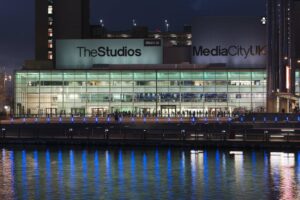
One of dock 10’s early challenges was to develop a viable solution to allow creative teams and editors to work and collaborate remotely, with minimal latency and fullscreen playback, while removing the need for post producers to act as brokers, manually allocating machines, scheduling, notifying, and brokering the connections many times a day.
The Challenge
The facility had been using Zscaler along with HP ZCentral Remote Boost for remote desktop access. Zscaler and HP ZCentral helped dock 10 to move away from their network infrastructure to the cloud securely, using the principles of zero trust for direct-to-cloud access, and secure cloud-to-cloud connectivity. Further, instead of assuming everything behind the enterprise firewall is safe, the Zero Trust model assumes breach and verifies each request as though it originates from an open network.
Jon Hatto, Senior Technologist at dock 10 explained that the HP ZCentral Remote Boost was being used as it had been free with HP workstations for many years although ZCentral as a free product is becoming obsolete at the end of 2022 and is being migrated to a subscription model as part of HP Anywhere.
“We use Remote Boost with HP workstations as part of our remote edit workflow,” continued Hatto. “We have up to 100 editors working remotely from outside of dock10. The main software we use that runs on the HP workstations is Avid Media Composer video editor along with MediaCentral | Production Management (media asset manager). Content is being stored using Avid NEXIS storage.”
Prior to integrating the Leostream/TGX solution, dock 10 had no broker software, thus leaving the job of their post producers to act as brokers by allocating machines to users and notifying them by email. This information was also separately recorded within their bookings scheduling system. As users are sometimes moved around remote machines several times per day, it became an onerous task to manually broker these connections. Hatto and his team also found that the HP Remote Boost software provided less than optimum usability over low-bandwidth, high-latency internet connections. As a result, the HP Remote Boost also was not able to allow users to run fullscreen video playback directly from the edit client software – the bandwidth requirements were often just too great.
The Solution
Continuing its search for the optimal remote workstation solution, dock 10 had initially tested the Teradici PCoIP display protocol solution and found that while it provided good performance on a high-bandwidth LAN, it struggled over typical internet broadband connections. dock 10 also disliked that they needed to purchase a separate broker subscription to provide the functionality they required.
“When we compared HP Remote Boost, Teradici and Mechdyne TGX, it was TGX every time that our users said they preferred using,” added Hatto. “TGX offers the ability for us to use fullscreen video playback within our application, something that no other system we’ve tested could offer. It allowed our users to work with lower bandwidth connections, in some cases, with sub-10Mb download speeds. Leostream’s remote desktop connection management technology just made access much easier, offering resource provisioning, monitoring, and optimization in a hosted desktop environment. What we were delivering with manual workflows and human interaction, we could now automate with the Leostream broker software. We are presently using the Leostream and TGX solution for remote access to our creative post production applications.”
“We use the Okta Identity Provider (IdP) to provide authentication to all our remote tools, Leostream included. This gives users true Single Sign On Access (SSO) to remote applications. We’re also developing a web-based tool to wrap all our remote applications together under one interface, using APIs and SDKs, where possible. For Leostream’s platform, we’re using the API to deliver completely reskinned access to the broker software, streamlining the user journey when working with dock10. Our operations team manages the deployment of the Leostream agent and the TGX sender on the remote PCs.”
“In a typical operation, users contact our Operations team to get the required software downloads. This includes the Zscaler client and the TGX receiver software. They install this on their device, either a Mac or PC. They connect to Zscaler using their Okta credentials and then click on the Leostream broker link we’ve sent them. Once they’ve logged into the Leostream broker link, again using their Okta credentials, they can connect to a machine. This then opens their local TGX receiver client and logs them into the remote PC. From here, users open the video editing tool and get to work creating their finished edits.”
The Leostream/TGX integrated solution has set a new level of performance and manageability for remote work and collaboration for dock 10’s creative team. Concluded Hatto, “The benefits afforded by our new solution are many, including: 1) automated brokering, removing the human interaction required to assign users to PCs; 2) the ability for users to run fullscreen video playback from the remote PC to local devices and 3) allowing users to work in more scenarios than before, e.g. if the quality or speed of their internet connection is poor, TGX would provide a better experience than any other remote display protocol we’ve tested.”

He is an active mentor and senior advisor to many established and VC backed start-up companies and incubators, a market/technology analyst, and has over three decades of experience in brand development, management consulting, company turnarounds, creative advertising and public relations.
View Cognitive Impact services at www.cognitiveimpact.com. Curtis can be reached at curtis@cognitiveimpact.com; Office: (714) 620-4993
- Bergamot Asset Management Acquires 50% Stake in Augspurger and Professional Audio Design - January 20, 2026
- Genelec offers 8381A point source main monitor - February 4, 2025
- Solid State Logic Launch SSL 18 Rackmount Audio Interface - February 4, 2025